Critical analysis
Why are people leaving GoHighLevel?
Some agency owners are no longer willing to trade product depth, simplicity, and control for one enormous feature list. Their frustration is not that HighLevel does too little. It is that the platform often promises more than the daily experience consistently delivers.
Researched by HighLevel vs Votel Editorial Team · Last verified September 13, 2026 · Methodology · We may earn a commission if you join Votel through our links. Details

The short answer
The convenience equation changed
People choose an all-in-one platform because consolidation should make the business easier. Some users are leaving when HighLevel's complexity, uneven feature depth, recurring instability, and client-support burden cost more than that consolidation saves. At the same time, AI-assisted coding has made focused alternatives cheaper and faster to create. The lock-in is weaker because the build versus buy decision is no longer what it was five years ago.
Five reasons
Why some agencies are reaching the exit
01
Breadth stopped compensating for shallow depth
An all-in-one platform loses its advantage when important features still require custom CSS, add-ons, workarounds, or separate products to become complete.
02
The complexity became an operating cost
More modules mean more settings, permissions, billing rules, training, troubleshooting, and client support. What looks consolidated on a feature list can remain fragmented in daily use.
03
Recurring instability exhausted goodwill
A failure that blocks a call, booking, workflow, payment, or client login is not a minor inconvenience to an agency. The client holds the agency accountable, not the software vendor.
04
HighLevel SaaS is often a service business in disguise
The agency still owns configuration, onboarding, education, billing exceptions, support, and recovery. Without enough margin for that labor, the model can become difficult to sustain.
05
AI-assisted development changed the alternative
Agencies can now prototype smaller, purpose-built tools faster. They do not always need a giant platform merely because custom software used to be too expensive or slow.
The core criticism
HighLevel keeps adding rooms to a house users already struggle to navigate
HighLevel does not have a shortage of releases, staff, documentation, or support activity. The criticism is that more activity is not the same as resolving the underlying product problem. Every added module brings another settings surface, permission model, billing rule, interface, and failure mode. Support can answer tickets about the consequences, but support headcount cannot make a fragmented product coherent.
This is where repeated assurances that an issue is being worked on begin to feel like lip service. Users are not asking whether a team has acknowledged the problem. They are asking whether the same class of problem still disrupts their work months or years later.
Motion is not the same thing as maturity. A long changelog can coexist with a frustrating product.
The skateboard problem
Shipping the first usable version is not the same as finishing the feature
A skateboard version of a feature can be smart product development. It validates demand quickly. The problem begins when the minimum version becomes the permanent experience while the roadmap moves on to the next category. Eight years of compounding partial solutions can produce an impressive demo and an exhausting operating system.
Our hands-on comparisons show the pattern in concrete places. HighLevel's calendar styling is far more limited without custom CSS, its agency level still requires a separate sub-account to run the agency's own CRM work, and its audit information is spread across different products. Read the evidence in our calendar, agency account, and activity and audit log comparisons.
HighLevel can reasonably answer that it serves an enormous market and cannot deepen every module at once. That is true. It is also the reason a buyer should judge the capability they receive today, not the maturity they hope a roadmap will eventually deliver.
Jack of all trades
Having every category is not the same as mastering any category
HighLevel has a built-in affiliate manager for its customers, chatbots, Ask AI, Voice AI, websites, funnels, calendars, communities, payments, social publishing, reporting, and many other products. The recurring frustration is not that those labels are missing from the menu. It is that too many tools feel adequate for a demo and incomplete under the pressure of daily client work.
The answer is often another fix, another release, or another few months of waiting. For years, users accepted that bargain because the alternative was buying and connecting many separate tools or funding custom development. They learned to smile at each incremental improvement because the platform was still the most practical option available.
An agency owner is not running a fan club for software releases. They are running a business.
Micro-releases matter when they complete a dependable workflow. They do not deserve applause merely because a long-standing limitation moved one step closer to usable. The standard is not whether the feature is improving. The standard is whether the agency can safely sell it, support it, and trust it today.
When vendors become product research
Marketplace partners face an uncomfortable power imbalance
We have received reports from former HighLevel team members that product personnel created or used accounts on competing platforms and HighLevel Marketplace apps to study their interfaces, workflows, and functionality. Those reports include concerns involving CloseBot and Assistable. We are withholding the identities of the people who spoke with us for their privacy.
We have not independently adjudicated those private reports, and we are not alleging source-code theft or unlawful reverse engineering. The narrower concern is about the power imbalance created when the operator of a marketplace can observe a vendor's proven product, introduce overlapping native functionality, and then control the environment in which that vendor must compete.
One part of that concern is public. CloseBot's co-founder wrote that HighLevel used objectives and other direct matches from CloseBot, that the replicated features were inspired by CloseBot, and that HighLevel acknowledged it should have communicated with the company earlier. CloseBot also said the native versions did not go nearly as deep. That account supports a broader product criticism: HighLevel can reproduce the visible outline of a specialist tool without matching the depth, integration, or maturity that made the original useful.
Read CloseBot's public account of the marketplace overlapSource note: This section includes confidential reports provided to the editorial team. Source identities are withheld for privacy. The private reports have not been independently adjudicated and should not be read as allegations of source-code theft or unlawful conduct.
Voice AI as a case study
A production phone call exposes the distance between a feature and a finished product
In our testing, HighLevel's Voice AI felt clunky long after its initial promise. Public user reports describe instruction-following problems, calendar limitations, data-handling concerns, latency, and deployments that worked in a simple demonstration but became unreliable in real booking scenarios. HighLevel has continued improving the product, and its 2026 agent-log tools now expose execution timelines, latency, transfers, raw data, and errors for troubleshooting.
Better diagnostics are useful, but they also illustrate the operator burden. An agency selling a phone agent must review failed steps, delays, transfers, prompts, outcomes, and CRM writes because every bad call reaches a real prospect. A product can be technically capable while still asking too much of the person responsible for the customer experience.
We cannot know how often individual HighLevel employees personally operate every feature, so we will not claim they do not use their own product as fact. What users can judge is the output. Too many workflows feel built from a technical checklist rather than from repeated end-to-end use by the agency, employee, and small-business customer who must live with the result.
Reliability and support
The agency absorbs the damage even when HighLevel resolves the incident
We counted 94 notices in HighLevel's public incident archive from January 1 through September 12, 2026. That is not 94 complete platform outages. Many were brief, regional, degraded-service events, and our critical examples exclude failures HighLevel attributed to outside providers. Even with those qualifications, the archive documents recurring disruption across business-critical services.
A client does not care that a vendor hired another support representative, created another escalation path, or posted a resolution notice. The client cares that the call connected, the lead received a reply, the booking worked, and the payment succeeded. When it fails, the agency spends its own trust to cover the platform's mistake.
Review the incident evidence and limitationsMobile reality
The mobile criticism is real, but it needs to be stated accurately
It would be inaccurate to say HighLevel has no mobile product. HighLevel released a redesigned mobile experience in 2026 across its HighLevel, LeadConnector, and white-label apps. That release is meaningful progress.
It also demonstrates how late fundamental mobile work remained. HighLevel's own announcement said some web modules, including Blogs and Funnels, were not yet available on mobile. A public feature request for a responsive web-based app also remains visible. The defensible complaint after eight years is not that mobile does not exist. It is that the full product still does not offer one consistent, complete experience across desktop web, mobile web, and the native app.
That distinction matters when a function is unavailable in the mobile app and an agency owner needs to open HighLevel's desktop web interface from a phone. These firsthand screenshots show the result: desktop-width navigation, controls, cards, and copy are compressed or pushed outside the mobile viewport instead of reorganizing into a usable mobile layout.
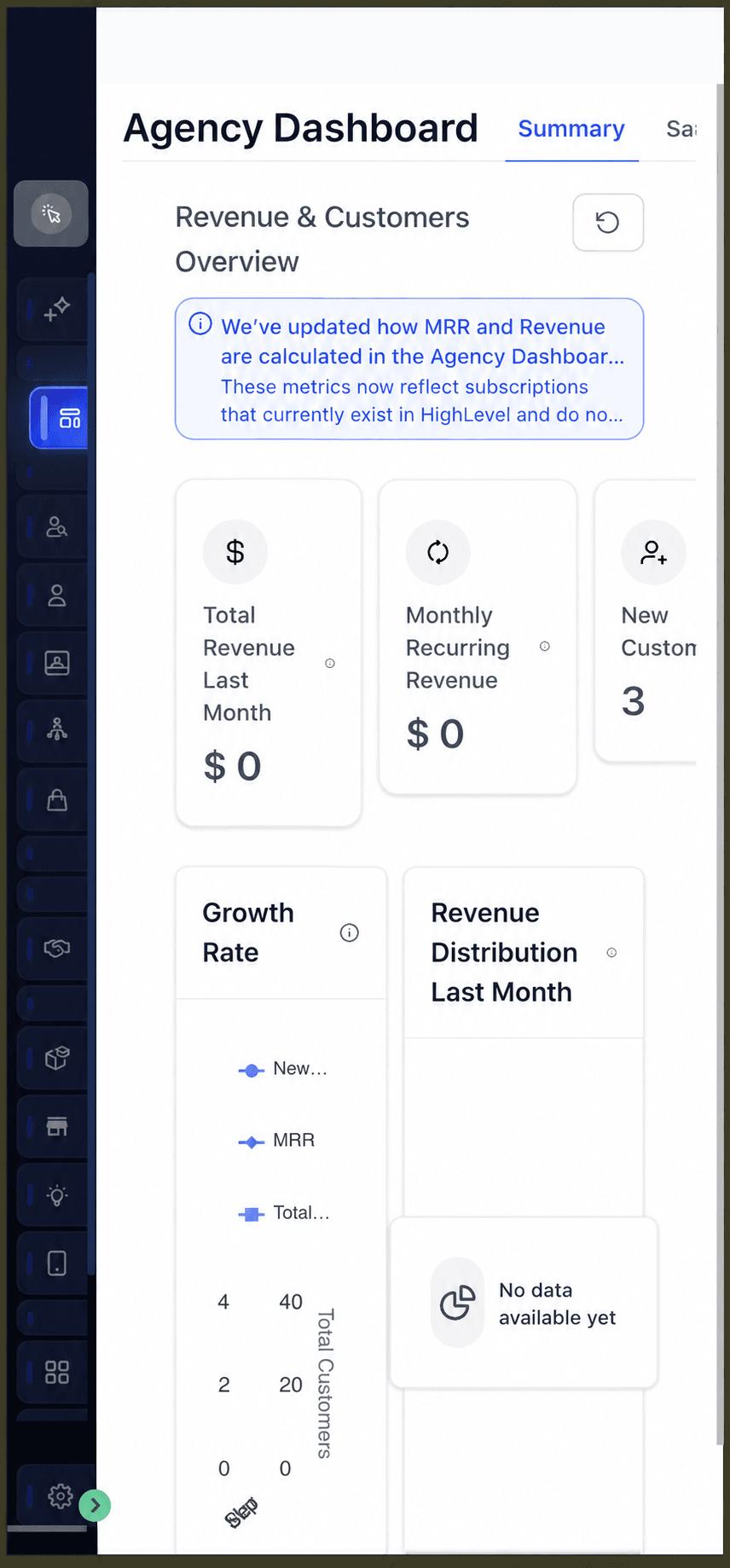
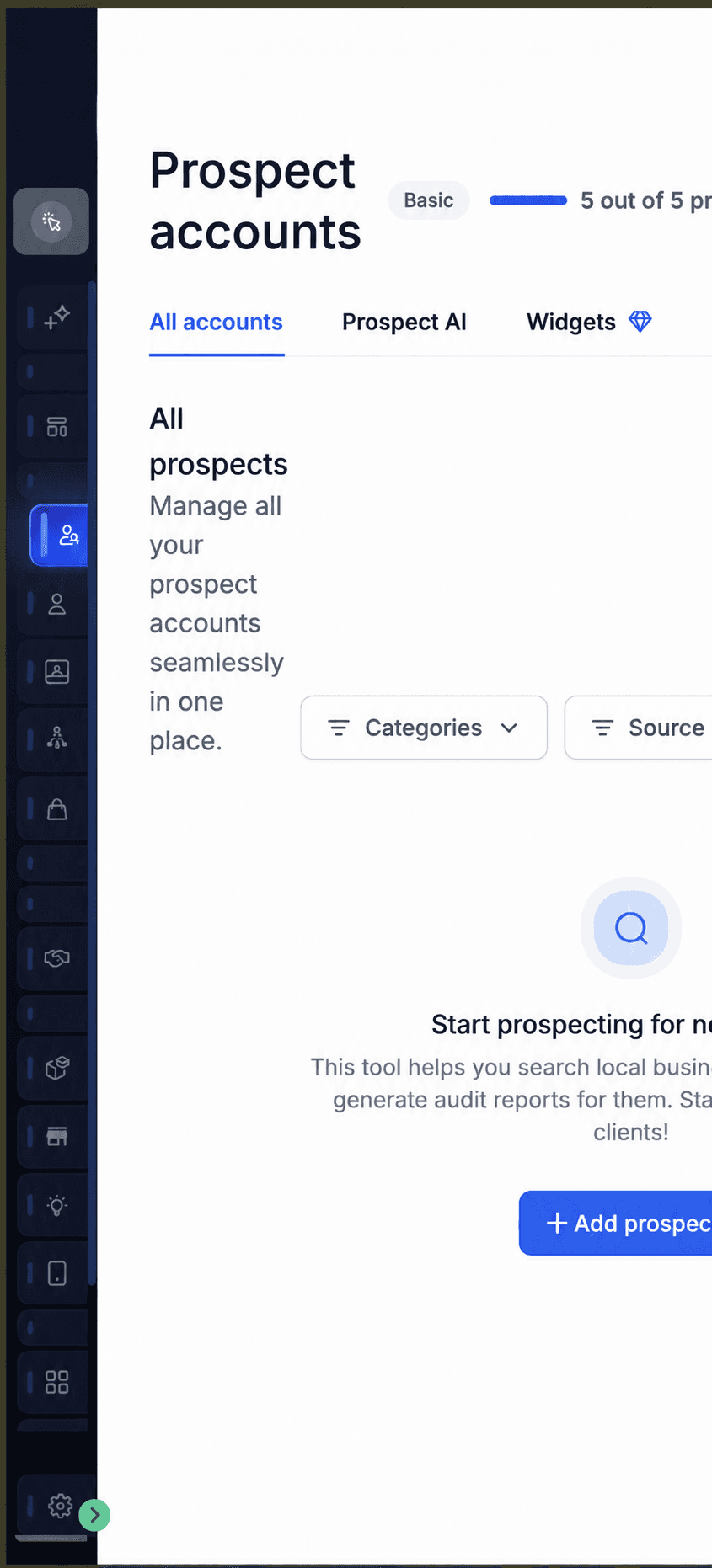
Firsthand screenshots captured September 13, 2026. The account logo was removed for privacy.
AI changed the build-versus-buy decision
Agencies can own more of the software layer than they could before
The 2025 Stack Overflow Developer Survey found that 84% of respondents were using or planning to use AI tools in development. GitHub reported that more than 1.1 million public repositories used an LLM SDK in 2025. That does not mean every agency owner has become a software engineer. It means the cost of turning a precise workflow into a small application has fallen sharply.
An agency can now build a focused portal, calculator, reporting layer, intake flow, internal tool, or niche workflow instead of forcing the requirement into a generic CRM module. This weakens the old argument that an all-in-one platform is the only affordable way to own software.
Vibe coding is not magic. Stack Overflow also found that 72% of respondents did not consider it part of their professional development work, while accuracy and debugging remained major concerns. Custom software still needs architecture, security, testing, monitoring, compliance, and an owner. AI expands the option set. It does not remove responsibility.
The SaaS promise
Reselling HighLevel is not passive software revenue
HighLevel's SaaS Configurator can automate checkout, sub-account creation, snapshots, and access. Its current setup guide also spans two billing architectures, a nine-step plan builder, payment providers, feature gates, add-ons, usage billing, snapshot behavior, and onboarding conditions. That is a capable system, but it is not a hands-off business.
Small-business customers still need the offer configured around their work, their staff trained, their messaging and domains connected, their automations tested, and their problems supported. If the agency sells a broad platform while pricing as though it were a self-serve utility, the support math eventually breaks. A viable HighLevel SaaS offer usually looks more like a tightly scoped managed solution than a generic software subscription.
There is also understandable channel tension. HighLevel still speaks directly to agencies, but it now publishes pages positioning itself as a CRM for small businesses too. That does not prove the company has abandoned agencies or is taking their customers. It does mean agency resellers should stop assuming that HighLevel's market positioning will always keep the platform invisible behind their white label.
The value equation
HighLevel was great for the price, not necessarily a great version of every product
For years, almost nothing could compete with HighLevel's combination of breadth and price. That distinction matters. The platform did not need to be the best affiliate manager, chatbot, funnel builder, calendar, voice agent, CRM, or reporting tool. It needed the combined package to cost less and create less friction than buying all of those products separately. For many agencies, it did.
That is why many long-time users called HighLevel fantastic when a more precise description was fantastic value. The difference was easy to ignore when there was no credible all-in-one competitor at the same price. It becomes impossible to ignore when deeper alternatives appear and AI makes custom, focused software more accessible.
HighLevel's real growth engine
The company affiliate program is excellent, and it helped turn users into distribution
This is separate from the affiliate-management feature inside the software. HighLevel's own company affiliate program pays a published 40% recurring commission on direct referrals and 5% on approved second-tier referrals. Without a shadow of a doubt, that is a compelling program.
Its smartest effect is not only promotion. Affiliates teach the product, publish tutorials, run communities, answer questions, create templates, and help referred customers remain successful. HighLevel's own affiliate documentation encourages affiliates to create groups where they can mentor referrals, noting that customer retention directly affects recurring payouts. HighLevel turned its users into a distributed education, support, and sales network.
We believe HighLevel would not have reached the same scale without that engine. That is an editorial inference, not a claim based on private attribution data. What can be verified is the unusually strong compensation, the ready-made promotional resources, and the direct financial reason affiliates have to help users learn and keep the platform.
The result is a massive distributed sales force producing tutorials, reviews, comparisons, webinars, communities, and social content. Of course that content tends to position HighLevel in the best available light. The people creating it earn money when viewers join and continue paying. That does not automatically make the content false, but it makes the public narrative structurally more positive than an ordinary customer conversation.
In our own conversations with HighLevel affiliates, we have heard frustration that rarely appears in their public content. Some are much more active in promoting and teaching HighLevel than in operating their own businesses inside the full platform. We cannot publish those private conversations as representative data, and we cannot quantify how common that behavior is. We can say the reluctance is understandable: criticizing the product publicly can threaten income, audience trust, access, and relationships inside the ecosystem.
We do not fault affiliates for responding to the incentive HighLevel deliberately created. Many work hard, teach the platform well, and provide more practical support than buyers would otherwise receive. A recommendation can be sincere and financially motivated at the same time. The buyer's job is to separate education from persuasion and price the implementation, training, deliverability, compliance, troubleshooting, and client support that begin after the sale.
What the evidence cannot prove
We cannot substantiate the claim that users are leaving in droves
HighLevel does not publish a current churn series that would let an independent reviewer measure how many agencies are canceling, downgrading, or keeping dormant accounts. Public complaint threads show real frustration and individual plans to leave. They do not reveal the rate across the full customer base.
The strongest version of this article therefore is not a fake statistic. It is a documented explanation of why the exit has become rational for some users. HighLevel remains useful to many agencies, has a large ecosystem, and continues to ship. The question is whether its breadth still creates more leverage than operational drag for your particular business.
Before you leave
Audit usage, not emotion
- 1. Measure actual usage. Identify which modules clients and staff used in the last 90 days.
- 2. Price the hidden labor. Count onboarding, support, fixes, custom CSS, add-ons, and failed-workflow recovery.
- 3. Separate commodity from differentiation. Keep standard infrastructure where it works and own the workflows that make your offer unique.
- 4. Pilot the alternative. Recreate one real, low-risk client workflow and test it end to end.
- 5. Preserve a rollback path. Export data and keep HighLevel active until the replacement passes a full operating cycle.
Frequently asked questions
Straight answers about leaving GoHighLevel
Why are people leaving GoHighLevel?
Some agency owners say the platform's complexity, uneven feature depth, reliability problems, support burden, and incomplete mobile parity now cost more than the all-in-one convenience saves. AI-assisted development has also made smaller custom alternatives more accessible.
Are GoHighLevel users canceling in droves?
There is no public, independently verified churn dataset that proves mass cancellation. There are current public complaints and migration discussions, but they establish dissatisfaction among some users, not the percentage leaving.
Is GoHighLevel mobile-friendly?
HighLevel has dedicated mobile apps and released a redesigned mobile experience in 2026. Its own release notes say some web modules, including Blogs and Funnels, were not yet available on mobile, and a separate request for a responsive web app remains public. The accurate criticism is incomplete parity, not the absence of a mobile app.
Can vibe coding replace GoHighLevel?
It can make focused internal tools, portals, calculators, dashboards, and workflow interfaces much easier to build. It does not automatically replace messaging compliance, deliverability, telephony, payments, security, monitoring, or ongoing maintenance.
Is a HighLevel SaaS business still viable?
It can be, especially with a narrow offer and strong implementation. The dangerous assumption is that software resale becomes passive income. HighLevel's own SaaS setup spans plan architecture, payments, snapshots, feature controls, usage billing, onboarding, and support decisions.
Should an agency cancel HighLevel immediately?
No. First measure which modules are actually used, what they cost to operate, and what would need to move. Test any replacement with one low-risk account and keep the source system available through validation.
Sources and further reading
- HighLevel official status and incident history
- HighLevel: revamped mobile app experience
- HighLevel Ideas: responsive web app request
- HighLevel: SaaS Configurator setup
- HighLevel: Voice AI agent logs and call details
- HighLevel: CRM for small businesses
- HighLevel: affiliate program and 40% recurring commission
- CloseBot: HighLevel, marketplace overlap, and replicated features
- Stack Overflow 2025 Developer Survey: AI
- GitHub Octoverse 2025
- DORA: State of AI-assisted Software Development 2025
- Public discussion: recurring bugs and performance frustration
- Public discussion: support escalation and plans to leave
- Public discussion: complexity and finding a narrower use case
- Public discussion: Voice AI limitations in real businesses
- Public discussion: Voice AI booking and data limitations
Public discussion links are examples of user experience, not representative polling. Read our editorial methodology and affiliate disclosure.